
Scores for all instruments: 16,000+ (active and growing), over 236,000 pages.
All genres and levels: Jazz & Blues, Rock & Pop, Classical & Contemporary, Film & Musicals;
books & biographies; methods, études, play-along tracks (MP3) for Jazz & Rock.
Access & benefits: US$15.99 one-time payment, valid for lifetime, full Library access.
Table of Contents

The best sheet music download from our Library.
Please, subscribe to our Sheet Music Library. Sheet music should be accessible and affordable for all musicians, from professionals to absolute beginners.
Noriyasu Takeuchi: The Quiet Architect of the Classical Guitar’s Popular Imagination
Introduction and Disambiguation
Noriyasu Takeuchi (竹内永和, born 1955) is one of Japan’s most influential classical-guitar arrangers, performers, and educators—a musician whose name may not headline international concert halls, but whose printed arrangements are played in living rooms, guitar studios, and examination halls around the world. His work sits at a rare intersection: classically trained technique, jazz-inflected harmonic awareness, and an almost missionary belief that popular and film music belong in the classical guitarist’s repertoire. Before proceeding, one clarification is necessary. A different Japanese guitarist named Noriyasu Takeuchi (竹内徳義) is associated with the rock band Siam Shade; the present article concerns the classical guitarist and arranger 竹内永和, whose career is documented through Gendai Guitar, Senzoku Gakuen College of Music, and a large body of published guitar scores.
Search your favorite sheet music in the Sheet Music Library Catalog



The Beatles - Michelle arr: 竹内永和 (Noriyasu Takeuchi)
Biography and Career
Takeuchi was born in Shinjuku, Tokyo, in 1955. His family background was unusually rich in both commerce and music: his ancestors ran a long-established sake business in Nihonbashi and Kanda, and his father was a bandsman. As a child, Takeuchi followed his father to dressing rooms and naturally picked up the ukulele and guitar. He is described as a true Edokko—a Tokyo native of several generations—and his later blend of urban sophistication and popular touch may owe something to that milieu.
He studied classical guitar with Kazumasa Ishizuki and Yoshi Sato, and later attended masterclasses by Leo Brouwer, José Luis González, and Oscar Ghiglia. His competitive record was strong: he won the fifth Newcomer Award (or Guitar Music Grand Prize, depending on the source) and took first prize at the seventh Guitar Competition, followed by third prize at the twenty-fifth Tokyo International Guitar Competition in 1983. In parallel with his musical training, he graduated from Waseda University’s Faculty of Literature, where he studied Japanese literature and wrote a graduation thesis on Kamo no Chōmei’s Hōjōki—an early sign of the literary and historical curiosity that would later inform his programme-building and teaching.


Search your favorite sheet music in the Sheet Music Library Catalog
From the 1980s onward, Takeuchi built a multifaceted career. He performed as a soloist and chamber musician, became a prolific arranger for Gendai Guitar and other publishers, and eventually joined the faculty of Senzoku Gakuen College of Music, where he teaches classical guitar and world music. His performing life has ranged from solo recitals of film music and bossa nova at the Kawagoe live house “Page One” to duo work with pianist Katsumi Shimomori, tango projects with violinist Naoki Kita, and concerto appearances with orchestras.
Musical Style, Harmony, and Technique
Takeuchi’s musical personality is best understood through the word arrangement. He is not primarily a composer of large original works, nor a specialist in the avant-garde; he is a mediator—a musician who translates the harmonic and rhythmic languages of pop, jazz, film, bossa nova, and tango into idiomatic classical-guitar texture. His arrangements have been described as “skeletal” in the best sense: they provide a complete, emotionally satisfying solo guitar piece when played exactly as written, yet they also leave space for the performer to add improvisatory touches. Chord symbols are often included, allowing jazz-oriented players to reharmonise or extend passages.
The harmonic vocabulary is essentially functional tonal harmony with a jazz-pop accent. Takeuchi favors extended chords, clear bass lines, and economical voicings. One observer notes that his arrangements are “faithful to the original popular song while using somewhat thin chords with tasteful, waste-free writing”—a description that captures his refusal to overfill the texture. The result is music that is accessible to intermediate players but never merely simplistic. His bass lines are particularly admired: in pieces such as “Moon River,” the bass motion is described as “elaborate” even within an otherwise simple arrangement, giving the solo guitar the illusion of a small ensemble.
Technically, Takeuchi draws on the full resources of the classical guitar—rest and free strokes, arpeggios, harmonics, glissandi, hammer-ons, and pull-offs—but he deploys them in the service of song rather than display. His bossa nova arrangements require the characteristic batida or chord-cutting technique, which he has said he learned by listening closely to Baden Powell records. His tango work with Naoki Kita’s Tangophobics demanded a study of “authentic tango guitar technique,” including marcato articulation, syncopated accompaniment, and the rhythmic flexibility that Argentine tango requires. In his violin-and-guitar duo arrangements, he writes idiomatically for both instruments, using double stops in the violin and independent contrapuntal lines in the guitar so that the two instruments “bring out a beautiful harmony”.
As a teacher, Takeuchi’s approach is explicitly harmonic and analytical. His faculty profile states that he begins with “fretboard harmony,” using concrete examples and live demonstration to help students understand chord construction, melodic harmonisation, and the rhythmic patterns of different world musics. He teaches arrangement not as a set of tricks but as the practical application of harmonic and rhythmic knowledge to actual repertoire, whether classical or popular. This pedagogical philosophy mirrors his own arrangements: they are models of how to reduce a song to its essential harmonic skeleton without losing its emotional identity.
Main Works and Arrangements
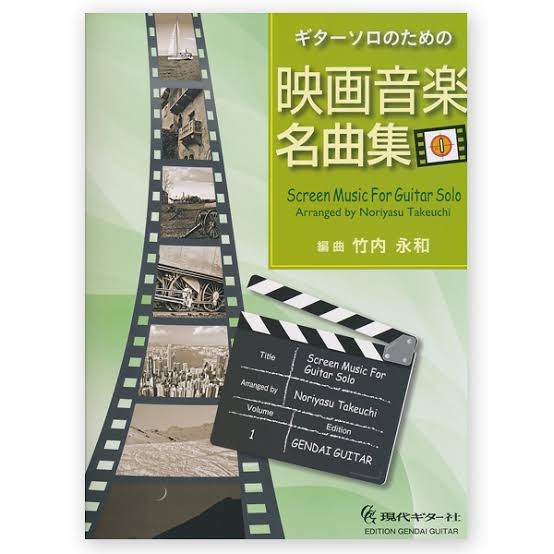
Because Takeuchi is primarily an arranger, his “best works” are best approached through the publications and recordings that carry his name. His largest and most influential project is the Popular Guitar Masterpieces series (『ポピュラーギター名曲集』, Vols. 1–7), published by Gendai Guitar from the late 1980s onward. These volumes established his reputation among amateur and semi-professional classical guitarists in Japan, and they remain a gateway to his style. Related collections include the Bossa Nova & Latin Masterpieces volume, two volumes of Yumi Matsutoya (Yuming) arrangements, a Southern All Stars collection, Guitar Solo Film Music Masterpieces Vols. 1–2, Japanese Pops, and the multi-volume J-Pop Taizen.
Among individual arrangements, several stand out. His guitar-duo suite from Ennio Morricone’s Nuovo Cinema Paradiso—comprising the Main Theme, “Prima Gioventù,” “Maturità,” and “Love Theme”—is widely performed and recorded. It has been released by guitar duos such as Matt Withers and Timothy Kain, and it appears on MusicBrainz as a Morricone/Takeuchi collaboration. His arrangement of the Beatles’ “Norwegian Wood” was written for Swedish guitarist Göran Sölscher and released on Deutsche Grammophon, giving Takeuchi an early international footprint. His JPOP instrumental album JPOP Guitar Best 1 includes arrangements of “Lion Heart,” “TSUNAMI,” “PRIDE,” “True Love,” and “Can You Celebrate,” among others—proof that his harmonic language can absorb Japanese pop balladry without losing the guitar’s classical poise.
His bossa nova and Latin collections include arrangements of Jobim’s “Wave,” “The Girl from Ipanema” (as “The Girl from Ipanema”/“Garota de Ipanema”), “Meditation,” “Felicidade,” “Manhã de Carnaval,” and “La Paloma”. His Ghibli album with Kenichi Ebe, Ghibli’s World with Classic Guitar, presents nineteen Studio Ghibli tracks in classical-guitar duo arrangements, including music from Nausicaä of the Valley of the Wind. He has also arranged Gershwin’s “Summertime,” “When You Wish Upon a Star,” “Moon River,” and “The Sound of Silence,” all of which circulate widely in guitar-teaching circles.
Original compositions exist, though they are less thoroughly catalogued than his arrangements. A music-festival profile claims a repertoire of “100 originals, 500 arrangements, and over 1,000 pieces including the classics,” and his Senzoku faculty recital programmes have included his own “黄昏のミロンガ” (“Twilight Milonga”). The Duo Sylphide albums—Fantasy Pas de Deux, Fairy Rondo, and Myth of Love—mix classical repertoire with original and arranged works and are important documents of his chamber-music persona.
Film Music
Takeuchi has not worked as a Hollywood or Japanese film-score composer in the conventional sense; his relationship to cinema is curatorial and interpretive. He has devoted multiple volumes to Guitar Solo Film Music Masterpieces, arranging themes from Cinema Paradiso, Mission: Impossible, The Graduate (“The Sound of Silence”), My Fair Lady (“The Rain in Spain”), The Sound of Music, and Studio Ghibli films. His Cinema Paradiso arrangements are probably his most famous film-music contribution: the guitar-duo version has been recorded by multiple international duos and is a staple of concert programmes. He has also performed film music in orchestral collaborations, including a Disney album with the Siena Wind Orchestra under Yutaka Sado and a film-music album with Ensemble Kanazawa under Yasumasa Takemoto. In this sense, his “music in films” is really film music after the film—music that extends the cinematic experience into the concert hall and the private guitar lesson.
Collaborations
Takeuchi is a generous collaborator, and his career is dotted with durable musical partnerships. With pianist Katsumi Shimomori he formed Duo Sylphide in 2003; the duo has performed at Tokyo Opera City, Oji Hall, Sumida Triphony Hall, and the Hyogo Performing Arts Center, and its three albums have been well received by Japanese music critics. With violinist Naoki Kita he has been a member of the genre-bending tango ensemble Tangophobics, whose self-titled 2002 album includes Piazzolla and classic tango repertoire and deliberately omits the bandoneon in favour of a chamber-jazz instrumentation. He has also collaborated with violinist Mayumi Hazama, flutist Iku Hayakawa, cellist Hiroaki Sakata, contrabassist Mizuko Yoshida, pianists Shizuka Shimoyama and Yukiko Isomura, and vocalists Akemi and Naomi Isomura, among many others.
His international collaborations, though fewer, are significant. The Göran Sölscher connection brought his Beatles arrangements to Deutsche Grammophon and introduced his name to guitarists outside Japan. His music has also been taken up by Australian guitarists Matt Withers and Timothy Kain, and by performers on international labels such as ABC Classic and Prima Classic, suggesting that his arrangements travel well beyond their Japanese pedagogical context.
Awards and Recognition
Takeuchi’s competitive honours—the fifth Newcomer Award/Guitar Music Grand Prize, first prize at the seventh Guitar Competition, and third prize at the twenty-fifth Tokyo International Guitar Competition—established his credentials as a performer. But his deeper recognition has come through his influence as an arranger and teacher. His books are mainstays of the Gendai Guitar catalogue; his arrangements are used in auditions and competitions; and his faculty position at Senzoku Gakuen places him at the centre of Japanese guitar pedagogy. The fact that his Cinema Paradiso and Ghibli arrangements have been recorded by non-Japanese artists is a further mark of international regard.
Influences
The decisive influence on Takeuchi’s musical outlook was Leo Brouwer, with whom he studied at a Gendai Guitar masterclass in 1980. Brouwer—composer, conductor, and one of the most important guitarists of the twentieth century—opened Takeuchi’s ears to a broader musical world, and Takeuchi has acknowledged this encounter as a turning point. Oscar Ghiglia and José Luis González provided further classical refinement. From the popular side, Baden Powell’s bossa nova recordings taught him the art of chord cutting and rhythmic independence, while Astor Piazzolla and the tango tradition gave him a model for combining sophisticated harmony with visceral rhythm. The Beatles and Japanese pop songwriters—Yumi Matsutoya, Southern All Stars, and the J-pop ballad composers—provided the raw melodic material that he transformed into guitar solos. His literary education at Waseda and his lifelong interest in Japanese culture also shaped the narrative and programme-building instincts that make his recitals feel curated rather than merely assembled.
Legacy and Significance
Takeuchi’s legacy is inseparable from the democratisation of the classical guitar in Japan. Before his generation of arrangers, the classical-guitar repertoire was dominated by Sor, Giuliani, Tárrega, and the Spanish romantics; popular music was often dismissed as a distraction from “serious” study. Takeuchi demonstrated that a Beatles song, a Morricone theme, or a J-pop ballad could be arranged with harmonic integrity and technical legitimacy, giving amateur players a reason to keep practising and giving teachers a bridge between the etude and the song. His arrangements are now part of the informal canon of Japanese guitar education: they appear in examination syllabi, in audition commentaries, and in the YouTube performances of guitarists around the world.
His pedagogical influence should not be underestimated. At Senzoku he teaches fretboard harmony, arrangement, and world-music rhythm, and his magazine serials in Gendai Guitar—“Popular Hit Repertoire” and “Popular Guitar Seminar for Classical Guitarists”—have trained a generation of players to think like arrangers rather than mere reproducers of notes. His insistence that arrangement begins with hearing the bass line, understanding the chord function, and respecting the original melody is a healthy corrective to the sometimes note-bound culture of classical-guitar pedagogy.
Finally, Takeuchi represents a distinctly Japanese model of the musician-as-mediator: a classically trained performer who never lost touch with the popular audience, a literary intellectual who chose the guitar as his medium, and an arranger whose name is better known in music shops than in concert programmes. His legacy lives less in a single masterpiece than in thousands of guitarists who, through his books, have discovered that the instrument can sing the music of their own time.
Noriyasu Takeuchi
Takeuchi’s published output is extensive and continues to grow. Recent releases include volumes of easy-listening film and standard repertoire, Japanese pop collections, and recordings of Nakayama Shinpei’s songs with flutist Iku Hayakawa. His work with orchestras—including the Siena Wind Orchestra and Ensemble Kanazawa—shows that his arrangements can scale from the private studio to the concert hall. For listeners new to his work, the Cinema Paradiso duo suite, the Ghibli’s World with Classic Guitar album, the Bossa Nova & Latin Masterpieces collection, and the JPOP Guitar Best 1 album together provide a representative cross-section of his art. In a field often divided between purism and populism, Noriyasu Takeuchi has quietly built a third way: classical technique in the service of song, and song in the service of the guitar.
Browse in the Sheet Music Library:
Or browse in the categories menus & download the Library Catalog PDF: