Scores for all instruments: 16,000+ (active and growing), over 236,000 pages.
All genres and levels: Jazz & Blues, Rock & Pop, Classical & Contemporary, Film & Musicals;
books & biographies; methods, études, play-along tracks (MP3) for Jazz & Rock.
Access & benefits: US$15.99 one-time payment, valid for lifetime, full Library access.
Table of Contents
Happy birthday, Stanley Clarke, born on this day in 1951
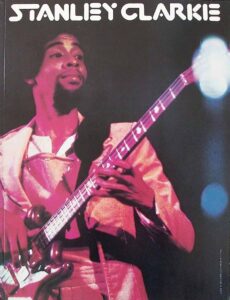
Stanley Clarke is an American bassist, composer and founding member of Return to Forever, one of the first jazz fusion bands.
Stanley Clarke Band - Full Concert [HD] | Live at North Sea Jazz Festival 2015
LINEUP Beka Gochiashvili (piano); Cameron Graves (keyboards); Stanley Clarke (bass); Michael Mitchell (drums).
The best Sheet Music download from our Library.

Please, subscribe to our Sheet Music Library.
Stanley Clarke: The Cosmic Architect of the Bass Universe
In the pantheon of jazz and fusion giants, Stanley Clarke stands not just as a master musician, but as a revolutionary force who fundamentally reshaped the role, sound, and perception of the bass guitar. More than just an innovator, Clarke is an architect, building sonic cathedrals where the bass was no longer confined to the foundation but soared as the lead voice, the melodic engine, and the rhythmic powerhouse. His career, spanning over five decades, is a testament to boundless creativity, technical mastery, and an unwavering commitment to pushing boundaries.
Search your favorite sheet music in the Sheet Music Library Catalog
From Philadelphia Roots to Acoustic Alchemy:
Born in Philadelphia in 1951, Clarke's musical journey began early. Initially drawn to the violin and cello, he switched to the double bass in his teens, quickly immersing himself in the rich traditions of jazz. He studied at the prestigious Philadelphia Musical Academy, absorbing the language of masters like Ron Carter and Paul Chambers. His early professional years saw him playing with jazz luminaries such as Art Blakey, Dexter Gordon, Stan Getz, Gil Evans, and Pharaoh Sanders. This grounding in acoustic bass provided a crucial depth and harmonic sophistication that would underpin even his most electrifying fusion work.
The Fusion Catalyst: Return to Forever and Beyond:
Clarke's trajectory shifted dramatically in the early 1970s when he joined pianist Chick Corea's groundbreaking ensemble, Return to Forever (RTF). Alongside Corea, Al Di Meola, and Lenny White (and earlier, Bill Connors and Flora Purim), RTF became synonymous with the explosive energy and complex structures of jazz-rock fusion. It was here that Clarke unleashed the full potential of the electric bass.
- The Electric Voice: Clarke didn't just play the bass; he commanded it. He adopted the Alembic bass, known for its sustain and clarity, and developed a tone that was uniquely his own – deep, growling, yet singing and articulate. He moved the bass from the background to the front line, trading fiery solos with Di Meola and Corea.
- Slap Revolution: While Larry Graham pioneered slap bass in funk, Clarke was arguably the first to fully integrate and sophisticate the technique within the complex harmonic and rhythmic frameworks of fusion. His percussive, funk-infused slapping and popping became a defining element of RTF's sound, adding a visceral, rhythmic drive heard on tracks like "Vulcan Worlds" and his own composition "Dayride."
- Melodic Mastery: Clarke possessed an extraordinary ability to craft intricate, lyrical melodies on the bass, often in the instrument's upper register. His solos weren't just displays of speed; they were compositions within compositions, filled with harmonic invention and emotional depth. Pieces like his iconic acoustic bass feature "Spain" (with RTF) showcased this beautifully.
Solo Ascent and the "School Days" Phenomenon:
Parallel to his work with RTF, Clarke embarked on a prolific solo career. His 1974 album, simply titled Stanley Clarke, was a bold statement, but it was 1976's School Days that became a cultural touchstone. The title track, with its unforgettable, intricate slap bass riff and driving energy, became an anthem. It wasn't just a hit; it was a manifesto. "School Days" demonstrated the electric bass as a complete instrument – capable of complex melody, blistering rhythm, and undeniable lead power. It inspired countless musicians and remains one of the most recognizable and influential bass lines ever recorded.
The Piccolo Bass: Expanding the Palette:
Never content to rest, Clarke sought new sonic territories. He became a pioneer of the piccolo bass – essentially a bass guitar tuned an octave higher, like a tenor guitar. This innovation allowed him to play lightning-fast lines in ranges previously inaccessible to bassists, further blurring the lines between bass, guitar, and even violin. He used it extensively on solo albums like Journey to Love and Modern Man, adding a unique, bright, and agile voice to his arsenal.
Collaboration, Versatility, and Legacy:
Clarke's career is defined by an astonishing breadth of collaboration:
- The Clarke/Duke Project: Teaming up with keyboardist George Duke resulted in a series of hugely successful, more R&B and funk-oriented albums (e.g., The Clarke/Duke Project) in the early 80s, producing hits like "Sweet Baby."
- Animal Logic: His venture with Stewart Copeland (The Police) and Deborah Holland explored art-rock and new wave textures.
- Virtuoso Ensembles: Projects like "Vertu'" (with Lenny White) and the acoustic "Trio!" (with Béla Fleck and Jean-Luc Ponty) showcased different facets of his genius.
- Generational Bridge: He formed the highly acclaimed SMV supergroup with fellow bass legends Marcus Miller and Victor Wooten, a celebration of the instrument's evolution that he helped drive.
- Film Scoring: Clarke also built a successful career composing for film and television (e.g., Boyz n the Hood, Romeo Must Die, The Transporter), demonstrating his compositional skills beyond the bass.
Beyond Technique: The Heart of the Innovator:
Stanley Clarke's innovation wasn't solely technical. It was conceptual. He fundamentally changed how the bass was heard and perceived in popular music. He proved it could be:
- A lead instrument capable of carrying complex melodies and improvisations.
- A powerful rhythmic engine driving intricate fusion compositions.
- A versatile voice spanning acoustic depth, electric growl, and piccolo brilliance.
- A foundation for cross-genre exploration, seamlessly blending jazz, rock, funk, R&B, and classical influences.
The Enduring Architect:
Today, Stanley Clarke remains a towering figure. A multiple Grammy winner, a NEA Jazz Master, and a tireless performer and educator, his influence permeates virtually every genre where the bass guitar is played. From Jaco Pastorius to Marcus Miller, Victor Wooten to Thundercat, and countless bassists across jazz, funk, rock, and beyond, the echoes of Clarke's revolutionary approach are undeniable.
He didn't just play the bass; he reimagined its possibilities, expanded its vocabulary, and elevated its status. Stanley Clarke, the cosmic architect, built a new universe for the bass, and we are all still exploring its vast and thrilling dimensions. His legacy is not just in the notes he played, but in the infinite potential he unlocked for the instrument and the generations of musicians who followed him.
Browse in the Sheet Music Library:
Or browse in the categories menus & download the Library Catalog PDF:
List of works by Stanley Clarke (on Wikipedia)